The Shift from Reactive to Ambient Intelligence
For the past decade, the smart home industry has been defined by reactivity. We issue voice commands to smart speakers, tap buttons on our smartphones to adjust thermostats, and set rigid, time-based schedules for our lighting. While this level of control was revolutionary when first introduced, it requires constant human intervention. The next frontier of smart home technology is shifting away from this manual paradigm toward ambient computing and predictive AI.
Ambient computing, a concept originally rooted in Mark Weiser's vision of 'ubiquitous computing,' describes an environment where technology recedes into the background of our daily lives. In the future smart home, you will not need to tell your house what to do; the house will already know. By leveraging advanced sensor fusion, edge artificial intelligence, and machine learning algorithms, tomorrow's smart home will anticipate your needs, optimize energy consumption autonomously, and adapt to your routines without a single manual input.
This transition from reactive gadgets to a cohesive, intelligent ecosystem represents the most significant leap in residential technology since the advent of the internet. In this guide, we explore the foundational technologies driving this shift, what they mean for your daily life, and how you can begin future-proofing your home today.
Key Technologies Driving the Predictive Smart Home
The realization of an ambient smart home relies on a convergence of several breakthrough technologies. These innovations are moving intelligence away from centralized cloud servers and placing it directly into the fabric of the home.
mmWave Radar and Advanced Presence Detection
Traditional Passive Infrared (PIR) motion sensors have long been the standard for smart home automation. However, PIR sensors only detect large, active movements. If you sit still on the couch reading a book, a PIR sensor will assume the room is empty and turn off the lights or adjust the HVAC system.
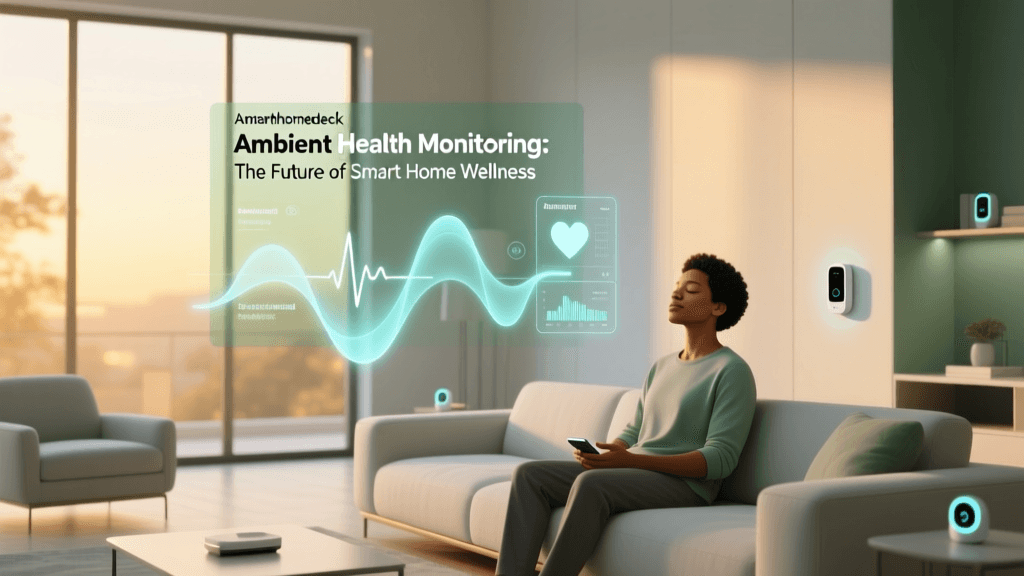
The future belongs to millimeter-wave (mmWave) radar. Originally developed for automotive and aerospace applications, mmWave sensors emit high-frequency radio waves that can detect micro-movements, including the subtle rise and fall of a human chest during breathing. Devices like the Aqara Presence Sensor FP2 utilize mmWave to map a room in multiple zones, determining not just if someone is present, but exactly where they are, their posture (standing, sitting, or fallen), and even their heart rate. This granular data allows for hyper-localized automation, such as directing a smart vent to blow warm air only toward the occupied side of a room.
Edge AI and Neural Processing Units (NPUs)
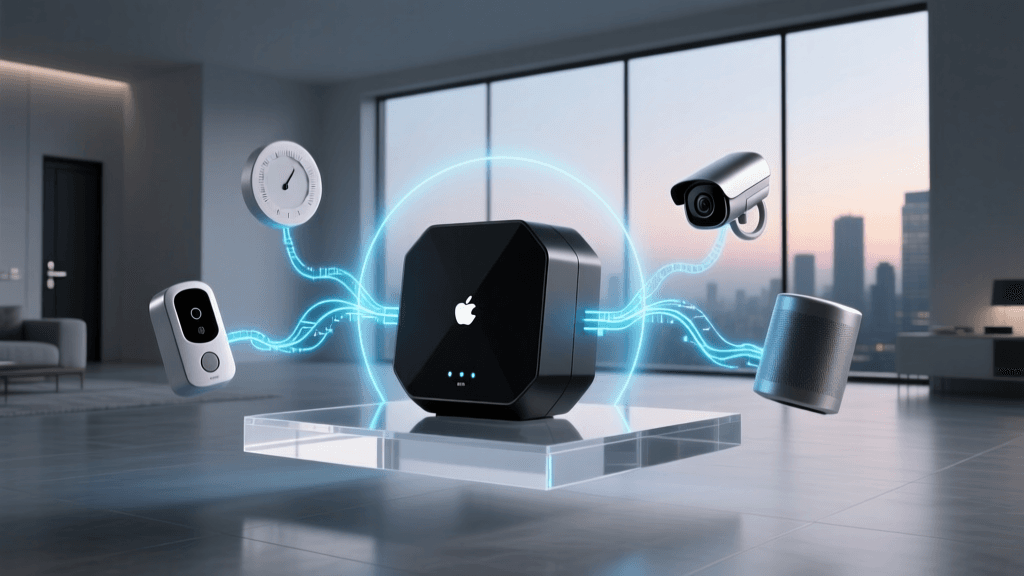
Processing the massive influx of data generated by mmWave, acoustic, and environmental sensors requires significant computational power. Relying on cloud processing introduces latency and privacy risks. The solution is Edge AI, powered by Neural Processing Units (NPUs) integrated directly into modern smart home hubs.
Edge AI allows the smart home to process complex machine learning models locally. For example, an AI-enabled smart camera can distinguish between a stray animal, a delivery driver, and a family member without ever sending video footage to an external server. According to guidelines established by the National Institute of Standards and Technology (NIST), securing IoT devices at the edge is critical for maintaining data integrity and user privacy, making local processing a cornerstone of future smart home architecture.
Energy Harvesting and Batteryless Sensors
As the number of sensors in a predictive home scales into the hundreds, replacing batteries becomes an environmental and logistical nightmare. The next generation of smart home devices will utilize energy harvesting technologies. Companies pioneering this space, such as those in the EnOcean Alliance, are developing switches powered by kinetic energy (the physical press of a button), indoor photovoltaic cells that harvest energy from ambient room lighting, and thermoelectric generators that pull power from temperature differentials on HVAC vents. This ensures a truly 'install and forget' ecosystem.
Predictive Automation: AI That Learns Without Programming
Currently, creating smart home routines requires manual programming (e.g., 'If motion is detected after 6 PM, turn on the living room lights'). Predictive AI eliminates the need for 'If/Then' logic by utilizing reinforcement learning.
By observing your behavior over time, a predictive AI hub learns your implicit preferences. It notes that you prefer the thermostat at 68°F when you are watching television in the evening, but prefer it at 64°F when you are sleeping. It cross-references this with local weather forecasts and dynamic electricity pricing to pre-cool or pre-heat your home during off-peak hours. The U.S. Department of Energy's Building Technologies Office has highlighted that AI-driven predictive HVAC optimization can reduce residential energy consumption by up to 20% without sacrificing occupant comfort, marking a massive leap forward for both sustainability and cost savings.
Comparison: Reactive vs. Proactive vs. Ambient
To understand the trajectory of smart home evolution, it is helpful to compare the current state of technology with the emerging and future paradigms.
| Feature Category | Reactive (Current Standard) | Proactive (Emerging Tech) | Ambient (Future Vision) |
|---|---|---|---|
| Lighting | Controlled via app or voice command. | Triggers based on basic PIR motion or sunset schedules. | Adapts color temperature to circadian rhythms and follows user presence via mmWave. |
| Climate Control | Manual adjustments via smart thermostat dial. | Geofencing (adjusts based on smartphone GPS location). | Predictive pre-conditioning based on AI routine learning, weather, and grid pricing. |
| Security | Manual arming/disarming; cloud-based alerts. | Geofenced auto-arming; basic local person detection. | Behavioral anomaly detection; acoustic glass-break analysis processed on Edge AI. |
| Entertainment | Selecting media via remote or casting from phone. | Voice-activated playback based on user voice profile. | Audio follows user room-to-room; displays surface relevant info based on time/context. |
Projected AI Integration in Smart Home Categories
As edge computing becomes cheaper and more powerful, AI integration will become ubiquitous across all device categories. The following chart illustrates the projected integration of predictive AI capabilities across major smart home sectors over the next five years.
How to Future-Proof Your Home Today
While true ambient computing is still on the horizon, the foundation is being laid right now. If you are investing in smart home technology today, you must prioritize interoperability and local processing to ensure your devices are not rendered obsolete in three years.
Adopt Matter and Thread
The single most important step you can take is to ensure your devices support the Matter application layer protocol and the Thread networking protocol. Matter ensures that devices from different manufacturers can communicate seamlessly without relying on proprietary cloud bridges. Thread provides a low-power, self-healing mesh network that prevents Wi-Fi congestion as your sensor count grows. The Connectivity Standards Alliance (CSA) maintains the official Matter standard, and looking for the Matter logo on packaging is now a mandatory checklist item for any future-proof purchase.
Invest in Local Hubs with Edge Processing
Transition away from hubs that require constant internet connectivity. Platforms like Home Assistant, Hubitat, and Apple's HomePod (acting as a Thread Border Router) prioritize local execution. When your internet goes down, a local hub ensures your predictive automations, motion sensors, and smart locks continue to function flawlessly.
Upgrade Your Network Infrastructure
An ambient home generates a continuous stream of telemetry data. To support this, upgrade your router to a Wi-Fi 6E or Wi-Fi 7 system, which offers dedicated bands for IoT traffic, ensuring that your smart home background processes do not interfere with your high-bandwidth activities like 4K streaming or video conferencing.
Privacy Considerations in an Always-Sensing Home
The transition to ambient computing requires a home that is constantly 'sensing' its environment. This raises valid privacy concerns. If your home knows when you sleep, what rooms you occupy, and your daily routines, that data is incredibly sensitive.
To mitigate these risks, the industry is adopting a 'privacy-by-design' approach. When building your future smart home, prioritize devices that utilize sensor fusion at the edge. This means the raw data (like radar point clouds or audio waveforms) is processed locally by the device's NPU, and only the metadata (e.g., 'Room Occupied = True') is sent to the central hub. Avoid devices that require continuous cloud processing for basic automation, and utilize network segmentation (like IoT VLANs) to isolate your smart devices from your personal computers and smartphones.
Conclusion
The era of shouting commands at a smart speaker is slowly coming to an end. The future of the smart home is ambient, predictive, and deeply integrated into the physical architecture of our living spaces. By leveraging mmWave radar, Edge AI, energy harvesting, and unified protocols like Matter, the next generation of smart homes will operate silently in the background, anticipating our needs, conserving energy, and enhancing our comfort. By understanding these foundational shifts and investing in local, interoperable technologies today, you can build a home that is not just connected, but truly intelligent.