The Shift from Fragmented Ecosystems to Unified Standards
For the past decade, the smart home industry has been defined by a frustrating reality: walled gardens. Consumers were forced to choose sides, aligning their purchases with Apple HomeKit, Google Home, Amazon Alexa, or Samsung SmartThings. A smart lock purchased for one ecosystem often refused to communicate with a smart lighting system from another, resulting in a fragmented user experience requiring multiple apps and redundant hubs. However, a massive market correction is currently underway, driven by the Connectivity Standards Alliance (CSA) and their flagship interoperability protocol: Matter.
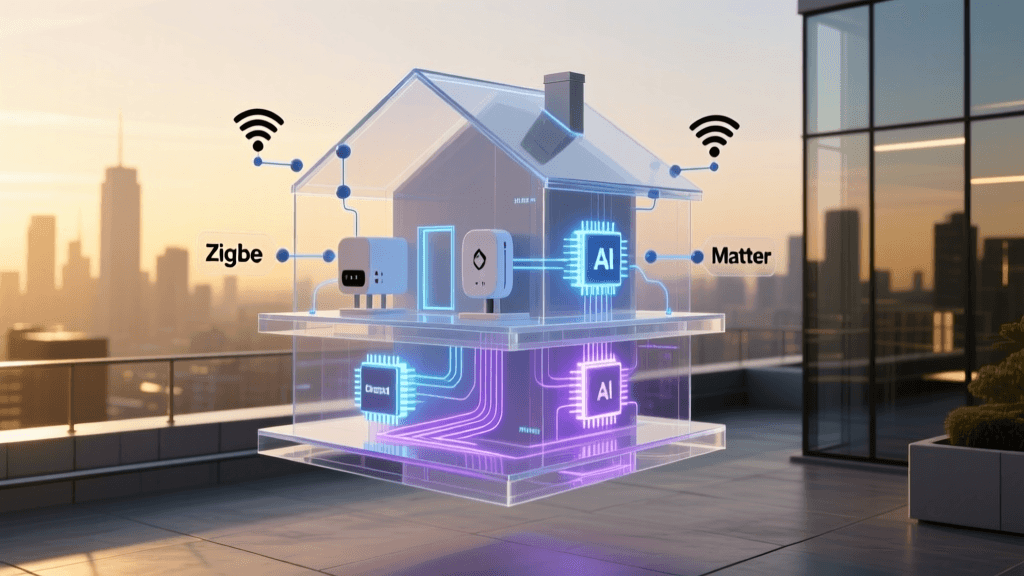
Matter is not just another wireless protocol; it is an open-source, IP-based connectivity standard that operates over existing network technologies like Wi-Fi, Ethernet, and Thread. Its primary mandate is to ensure that a certified device will work seamlessly across all major smart home platforms simultaneously. This industry-wide truce, backed by over 280 member companies including Apple, Google, Amazon, and Samsung, is fundamentally altering market dynamics. Manufacturers no longer need to produce three different SKUs of a smart plug to support three different voice assistants. Instead, they build a single Matter-compatible device, reducing R&D costs and accelerating consumer adoption.
The Power of Multi-Admin Control
One of the most revolutionary, yet under-discussed, features of Matter is 'Multi-Admin' capability. In the pre-Matter era, linking a device to a secondary platform often required complex cloud-to-cloud bridging, which introduced latency and privacy concerns. Matter allows a single smart device to be securely paired to multiple ecosystems at the local network level. For example, a household where one partner uses an iPhone (Apple Home) and the other uses an Android device (Google Home) can now control the exact same Matter-certified smart thermostat or door lock natively, without relying on third-party cloud servers. This local LAN control drastically reduces latency, ensuring that when you press a button, the action is instantaneous.
Under the Hood: Thread and the Modern Mesh Network
While Matter dictates the language devices use to communicate, it relies on underlying transport protocols to carry the signal. For high-bandwidth devices like security cameras and smart displays, Wi-Fi remains the standard. However, for low-power sensors, smart bulbs, and motorized blinds, Matter leverages Thread, a low-power, IPv6-based mesh networking protocol.
Unlike traditional Wi-Fi, where every device connects directly to a central router (often causing network congestion when dozens of smart bulbs are added), Thread devices connect to one another, forming a resilient mesh. If one smart plug loses its direct connection to the router, it simply routes its signal through a neighboring Thread device. To connect a Thread mesh to your home's IP network, a 'Thread Border Router' is required. Fortunately, many modern smart home hubs—such as the Apple TV 4K (3rd Gen), Amazon Echo (4th Gen), and Google Nest Hub (2nd Gen)—have Thread Border Radios built directly into their hardware.
Protocol Comparison: Legacy vs. Next-Generation
Understanding the transition from legacy protocols to the Matter/Thread paradigm is crucial for making informed purchasing decisions. Below is a technical comparison of the dominant smart home protocols.
| Protocol | Frequency | Mesh Support | Power Draw | Matter Compatibility | Primary Use Case |
|---|---|---|---|---|---|
| Wi-Fi 6 | 2.4 / 5 / 6 GHz | No (Traditional) | High | Native | Cameras, Displays, Hubs |
| Zigbee 3.0 | 2.4 GHz | Yes | Very Low | Via Bridge Only | Legacy Sensors, Bulbs |
| Z-Wave Plus | 908.42 MHz (US) | Yes | Very Low | Via Bridge Only | Security, Locks, Blinds |
| Thread | 2.4 GHz | Yes (IPv6) | Low | Native | Sensors, Lighting, Switches |
| Bluetooth LE | 2.4 GHz | Limited | Very Low | Native (Commissioning) | Device Setup, Proximity Locks |
The Rise of AI and Ambient Computing
Interoperability is only half of the smart home revolution. The second half is the transition from reactive control to predictive ambient computing. Coined by Mark Weiser in the early 1990s, ambient computing envisions a world where technology is woven into the fabric of everyday life, operating quietly in the background without demanding direct user interaction.
In the current market, AI is shifting the smart home from a command-based model ('Hey Siri, turn off the living room lights') to a context-aware model. Modern smart home platforms are integrating machine learning algorithms that analyze historical data, occupancy patterns, and environmental variables to automate the home proactively.
mmWave Radar vs. Traditional PIR Sensors
A critical hardware enabler of ambient computing is the shift from Passive Infrared (PIR) motion sensors to millimeter-wave (mmWave) radar sensors. Traditional PIR sensors, found in most basic security systems, only detect significant changes in heat signatures, meaning they fail to detect a person sitting still and reading a book, often resulting in the lights turning off prematurely.
mmWave sensors, such as the Aqara Presence Sensor FP2 (retailing around $65), emit high-frequency radio waves that can detect micro-movements, including the subtle rise and fall of a human chest during breathing. When combined with AI-driven routines, mmWave data allows the home to understand not just if a room is occupied, but where the occupant is and what they are doing. This granular data allows HVAC systems to direct airflow only to occupied zones, drastically improving energy efficiency.
Market Analysis: Growth Projections and Consumer Adoption
The adoption of unified standards and AI capabilities is driving a massive surge in smart home hardware deployments. Industry analysts project that the elimination of ecosystem lock-in will lower the barrier to entry for mainstream consumers who were previously intimidated by compatibility matrices.
Projected Growth of Matter-Certified Devices
As the chart illustrates, the proliferation of Matter-certified devices is expected to grow exponentially. Early adopters in 2022 and 2023 focused primarily on smart plugs and basic lighting. However, the 2024-2026 wave is dominated by high-value, complex appliances: smart locks, garage door controllers, whole-home energy management systems (HEMS), and AI-integrated HVAC controllers.
Furthermore, the U.S. Department of Energy has highlighted that smart home technologies, particularly AI-driven thermostats and automated shading, play a pivotal role in residential energy conservation and grid-load balancing. As utility companies begin to offer demand-response rebates, the financial incentive to install smart, networked appliances will further accelerate market penetration.
Practical Buyer's Guide: Future-Proofing Your Home
If you are entering the smart home market or looking to upgrade an existing fragmented setup, strategic hardware selection is vital. Here is an actionable guide to building a future-proof, ambient-ready ecosystem.
1. Invest in a Multi-Protocol Hub with Thread
Do not rely solely on your Wi-Fi router to manage smart home traffic. Invest in a dedicated hub that acts as a Thread Border Router and supports Matter natively.
- Apple TV 4K (3rd Gen, Wi-Fi + Ethernet): Priced around $149. Offers robust Thread border routing, local Matter processing, and leverages Apple's secure enclave for privacy-focused AI automation.
- Amazon Echo (4th Gen): Priced around $99. Contains both Zigbee and Thread radios, making it an excellent bridge for transitioning legacy Zigbee devices into a modern Matter ecosystem.
- Google Nest Hub (2nd Gen): Priced around $99. Ideal for visual feedback and utilizes Google's advanced AI for predictive home routines based on Nest camera and thermostat data.
2. Upgrade to AI-Powered Climate Control
Climate control represents the largest energy expenditure in a typical home. Upgrading to an AI-driven thermostat like the Ecobee Smart Thermostat Premium ($249) or the Google Nest Learning Thermostat ($279) is a high-ROI investment. These devices utilize remote room sensors to map occupancy and use machine learning to pre-cool or pre-heat your home based on your historical schedule and real-time local weather data, optimizing for both comfort and utility rates.
3. Prioritize Local Control for Security Devices
When purchasing smart locks (e.g., Yale Assure Lock 2, ~$239) or garage door controllers, ensure they are Matter-over-Thread certified. Security devices must operate locally. If your internet connection drops, a cloud-dependent lock may fail to execute local automations or log entries. Matter-over-Thread ensures that your lock communicates directly with your local hub, maintaining security and automation integrity even during ISP outages.
Privacy and Security in an AI-Driven Home
As homes become more intelligent, the volume of telemetry data generated increases exponentially. AI routines require data regarding when you wake up, when you leave for work, and how long you spend in specific rooms. This raises valid privacy concerns.
The Matter protocol addresses hardware security through a strict requirement called the Device Attestation Certificate (DAC). Every Matter-certified device contains a unique, factory-installed cryptographic certificate that proves its authenticity to the network. This prevents malicious, uncertified hardware from spoofing its way onto your local network. Furthermore, because Matter prioritizes local LAN communication, the data required to trigger a routine (e.g., 'motion detected in hallway, turn on lights') stays within your home's firewall, rather than being routed to a cloud server in another country.
However, for advanced AI features—such as Google's Nest Aware facial recognition or Amazon's Alexa Hunches—cloud processing is often still required. Consumers must carefully audit their privacy settings, opting for local processing where available (such as Apple HomeKit's Secure Video, which routes camera feeds through a local HomePod before encrypting them to iCloud) and disabling unnecessary cloud-based telemetry on devices that do not strictly require it.
Conclusion: The Invisible Smart Home
The future of the smart home market is not about adding more screens, more apps, or more complex voice commands. The ultimate goal of the industry, driven by the unifying force of Matter and the predictive power of AI, is invisibility. Ambient computing dictates that the best technology is the technology you do not have to think about. By investing in Thread-enabled infrastructure, prioritizing Matter-certified devices, and embracing AI-driven sensors, consumers can transition their homes from a collection of remote-controlled gadgets into a truly intelligent, autonomous living space that adapts seamlessly to their lives.